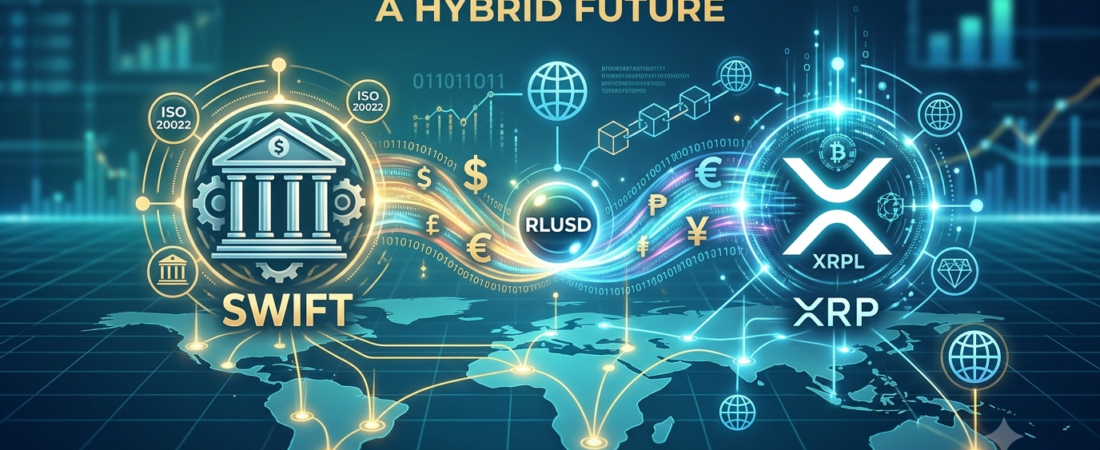
The cross-border financial landscape is moving away from single-network dominance. Today, institutional banking centers on hybrid coexistence—combining legacy financial frameworks with distributed ledger technology (DLT) to mitigate multi-trillion-dollar liquidity frictions.
The transition of legacy banking to the structured ISO 20022 messaging standard has leveled the playing field, allowing data to move seamlessly between traditional networks and the XRP Ledger (XRPL). At the center of this ecosystem sits Ripple’s dual-token framework: XRP, the native utility asset of the XRPL, and RLUSD, Ripple’s highly regulated, fiat-backed stablecoin.
1. Where XRP Could Be Used (The Technical Capability)
XRP was engineered to eliminate the “trapped liquidity” problem inherent to legacy cross-border corridors. Under the traditional correspondent banking model, financial institutions must maintain pre-funded bank accounts (known as Nostro/Vostro accounts) in local currencies globally just to ensure international transfers can execute.
XRP serves as an On-Demand Liquidity (ODL) bridge asset. Instead of keeping millions of dollars dormant in foreign bank accounts, a sender bank holds its domestic fiat, swaps it for XRP in 3 seconds, routes it over the XRPL, and settles it into the destination currency on the other side.
[Sender Fiat] ──(3 Secs)──> [ XRP ] ──(3 Secs)──> [Receiver Fiat]
 (Local Bank)                                      (Global Bank)
Beyond standard remittance, XRP is architected for broader interoperability use cases:
- A Neutral Rail for Wholesale CBDCs: As nations launch Central Bank Digital Currencies (CBDCs) and tokenized deposits, they encounter systemic fragmentation (e.g., a digital Euro ledger cannot naturally speak to a digital Yen ledger). XRP is positioned to serve as a neutral, high-speed intermediary exchange rail.
- Tokenized Real-World Assets (RWAs): Utilizing the native Automated Market Maker (AMM) capabilities built directly into the XRPL, XRP functions as the baseline liquidity pair, allowing institutions to trade tokenized assets instantly.
2. Will It Be Used, and How Is It Being Used?
To assess actual institutional adoption, a clear distinction must be made between Ripple (the financial technology enterprise) and XRP (the open-source digital asset).
The Network Adoption vs. Asset Adoption Split
Ripple’s enterprise software infrastructure has achieved deep integration among global banking groups, including Mastercard, SBI Holdings in Japan, and regional entities like Europe’s AMINA Bank. However, deploying Ripple’s messaging software does not automatically mandate the use of the XRP token. Many institutions prefer to settle transaction flows using local fiat currencies or highly compliant stablecoins.
Active Institutional Breakthroughs
XRP utility is breaking through predominantly where traditional banking pain points are most severe: high-friction, low-liquidity currency corridors.
- The Exotic Corridor Strategy: Tier-1 banks do not need a crypto-asset to trade USD for Euros; that market is already highly liquid and cost-effective. Instead, XRP finds its utility in corridors like the US Dollar to Mexican Peso, or the Japanese Yen to Philippine Peso, where pre-funding accounts is highly capital-inefficient.
- Regulated Custody Infrastructure: Tier-1 banking groups like Standard Chartered, BBVA, and DBS have heavily integrated institutional digital asset custody. As these major institutions build the internal compliance layers required to hold crypto-assets, the friction for corporate treasuries to utilize XRP directly for backend settlement drops significantly.
3. Defining the Core Profiles: XRP vs. RLUSD
While both tokens run natively on the XRP Ledger, they are engineered for entirely separate treasury management profiles.
| Attribute | XRP | Ripple USD (RLUSD) |
| Asset Type | Floating-rate, native utility crypto-asset. | Fiat-backed, US Dollar-pegged stablecoin. |
| Value Anchor | Market-driven supply and demand. | 1:1 backed by cash deposits and short-term Treasuries. |
| Primary Utility | Cross-border bridge asset for illiquid currency pairs. | Predictable store of value, settlement collateral, and DeFi pair. |
| Launch Framework | Open-source decentralized launch (2012). | Launched under NYDFS Trust Charter via Standard Custody & Trust. |
| Multichain Footprint | Native to XRPL. | Native to XRPL and Ethereum; expanding via Wormhole’s NTT standard. |
4. Where XRP and RLUSD Converge and Compete
A common industry misconception is that RLUSD was created to replace XRP. In reality, they serve as complementary instruments inside the same institutional ecosystems.
The Corporate Hedging vs. Capital Efficiency Split
The defining boundary between these two assets is how an enterprise manages volatility risk:
- XRP for Capital Efficiency: Institutions utilizing XRP do so to free up capital. Because an ODL transaction settles in roughly 3 to 5 seconds, the bank’s exposure to cryptocurrency price volatility is minimized to a microscopic window of time.
- RLUSD for Risk Aversion: For commercial use cases where value must remain on-chain for hours, days, or weeks—such as trade finance escrows, corporate payroll, or commercial lending collateral—holding a volatile cryptocurrency on a balance sheet is prohibited by risk compliance. As documented in Eco’s Comprehensive RLUSD Analysis, RLUSD provides the speed advantages of the XRPL without exposing institutional treasuries to market fluctuations.
While global banks use these digital rails to optimize massive, multi-trillion-dollar liquidity flows, the underlying principle of maximizing capital efficiency is the same for individual investors. When building a personal portfolio, understanding the long-term impact of rising corporate payouts is just as critical as high-speed settlement. For investors focusing on long-term wealth, applying a Yield on Cost framework allows you to accurately measure the true power of your investments over time as dividend payouts grow.
Direct Settlement Routing
The two assets do not compete; they optimize different settlement paths. For deeply liquid fiat paths, banks default to tokenized deposits or stablecoins like RLUSD.
For exotic or illiquid paths, creating individual stablecoins for every minor currency on Earth is mathematically inefficient. Instead, XRP serves as the universal matching rail, allowing a bank to bridge a highly liquid digital dollar asset (like RLUSD) directly into an illiquid local fiat currency on the backend.
5. The Structural Reality: SWIFT vs. DLT Ecosystems
The historical thesis that digital assets would cleanly dismantle SWIFT has been replaced by a reality of technological convergence. Rather than stepping aside, legacy financial networks have systematically integrated blockchain layers into their core infrastructure.
- SWIFT’s Orchestration Layer: SWIFT has completed the design phase and progressed directly into a live blockchain-based shared ledger MVP implementation. As detailed on SWIFT’s Official Innovation Portal, this ledger acts as a digital orchestration layer that records and validates interbank commitments, allowing banks to use their internal tokenized deposits to facilitate 24/7 cross-border payments.
- Enterprise Treasury Integration: Bridging the infrastructure gap from the corporate side, Ripple’s treasury management business (built on its acquisition of GTreasury) provides a unified operating plane. While the platform utilizes GTreasury’s traditional SWIFT cloud connectivity (such as Alliance Lite2) to let corporate finance teams process standard multi-bank messaging, it also natively supports digital asset dashboards for tracking XRP and RLUSD liquidity.
- Project Agorá and Wholesale CBDCs: In the largest public-private banking collaboration to date, the Bank for International Settlements (BIS) and the Institute of International Finance (IIF) launched the prototype phase of Project Agorá. As highlighted by the Bank of Canada’s Project Agorá Briefing, this initiative unites major central banks (including the Federal Reserve Bank of New York, the Bank of England, and the Bank of Japan) with over 40 private financial institutions to test a unified programmable ledger that combines tokenized commercial bank money with wholesale central bank reserves for atomic cross-border settlement.
According to an analytical review by Ledger Insights on Project Agorá’s Architecture, the financial system is intentionally separating tokenized commercial bank deposits onto a “unifying ledger” while keeping central bank money under domestic jurisdictional authority. This structural evolution solidifies the roles of alternative rails like XRP and RLUSD. They are specialized, plug-and-play components inside a multi-rail architecture. Banks route payments dynamically: using SWIFT’s shared ledger for primary interbank flows, stablecoins like RLUSD for regulatory-compliant digital dollar settlements, and XRP for instant liquidity in high-friction, exotic corridors.
6. Frequently Asked Questions (FAQ)
How do SWIFT messaging and blockchain assets like XRP interact in a hybrid model?
In a hybrid model, networks separate the communication of a transaction from its financial settlement. SWIFT serves as the global messaging backbone—transmitting complex, compliance-heavy data such as KYC (Know Your Customer) and AML (Anti-Money Laundering) records across its 11,000-bank network. Once the payment instruction is cleared by SWIFT, the transaction triggers backend blockchain networks like the XRP Ledger to execute the instant, low-cost movement of value.
Why does traditional cross-border settlement require alternative liquidity assets?
Traditional SWIFT does not physically move money; it only transmits payment instructions. The actual transfer of value depends on a fragmented network of correspondent banks. To clear these payments safely, banks are forced to park an estimated $27 trillion in pre-funded Nostro and Vostro bank accounts worldwide. Utilizing digital assets and real-time ledgers eliminates this capital inefficiency, allowing banks to settle funds on-demand rather than leaving massive amounts of capital idle in foreign jurisdictions.
How does XRP deliver On-Demand Liquidity (ODL)?
XRP delivers liquidity by functioning as a universal matching asset between two completely different fiat currencies. Through Ripple’s ODL mechanism, a domestic currency is instantly converted into XRP, sent across the XRP Ledger in 3 seconds, and immediately converted into the local destination fiat on the receiving end. This process completely bypasses the need for intermediary banks and eliminates traditional multi-day clearing delays.
Will XRP fully replace the SWIFT network?
No. While the XRP Ledger is technologically faster and cheaper for settlement, global finance is governed by deeply entrenched networks and trusted legal relationships. SWIFT possesses a 50-year structural moat. The future points to displacement in specific corridors (such as emerging market remittances) and deep integration into wholesale banking cores, rather than a total replacement of the legacy infrastructure.
7. Trustworthy Industry Documentation & Verification
To verify the real-time compliance frameworks, reserve structures, and network integrations driving this dual-token environment, consult these verified primary references:
- On Stablecoin Reserves and Regulation: To verify the regulatory compliance and monthly third-party accounting attestations required under its New York Department of Financial Services (NYDFS) limited-purpose trust charter, see the Ripple USD Official Transparency Portal.
- On Enterprise Stablecoin Comparisons: To review how state and federal regulatory frameworks impact bank counterparty risk and institutional asset allocation between leading digital dollars, review Eco’s Head-to-Head Comparative Study.
- On SWIFT’s MVP Implementation: To inspect the technical specifications, smart contract rules, and bank coordination mechanics of SWIFT’s interbank tokenized deposit rails, read SWIFT’s Official Blockchain Shared Ledger Progress Report.
- On Global Central Bank Ledgers: To explore how tokenized money, settlement finality, and privacy-enhancing technologies are being systematically tested across major reserve currencies, refer directly to the BIS & IIF Project Agorá Framework.